
The Peninsular Plateau


  • The peninsular plateau is a tableland composed of old crystalline, igneous and metamorphic rocks.
  • It was formed due to the breaking and drifting of the Gondwana land.
  • This plateau consists of two divisions namely the central highlands and the Deccan plateau.

Central highlands:

  • The part of the peninsular plateau lying to the north of the Narmada river, covering a major area of malwa plateau is known as central highlands.
  • The Vindhya range is bounded by Satpura in south and Aravalli in the northwest.
  • The rivers Chambal, the sind, the betwa, and ken are flowing from southwest to northeast.
  • The central highlands are wider in the west and narrow in the east.
  • The eastward extension of this plateau is locally called Bundelkhand and Baghelkhand.
  • The Chota Nagpur plateau marks the further eastward extension central highlands.
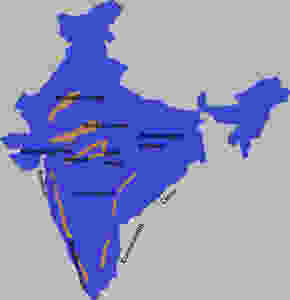


Deccan Plateau :

  • Deccan plateau lies south of the Narmada river.
  • Satpura range is on the north of Deccan plateau, Mahadev, the kaimur hills, and mailkar range are the eastward extension of the Satpura range.
  • Deccan plateau is higher in the west i.e... Deccan plateau is slightly tilted toward the east.
  • Western and eastern ghats are edges of the west and east of the Deccan plateau respectively.
  • western ghats lie parallel to the western coast, they are continuous, western ghats are higher than the eastern ghats.
  • Eastern ghats are discontinuous, the rivers drain into the Bay of Bengal.
  • The average elevation of western ghats is 900 meters -1600 meters.
  • The average elevation of eastern ghats is 600meters.
  • The height of western ghats increases from north to south.
  • The highest peak in the western ghat is Anai Mudi (2,695 meters), Doda Betta (2,637 meters).
  • Mahendragiri(1,501 meters) is the highest peak in the eastern ghats.
  • One of the distinct features of the peninsular plateau is the black soil area known as Deccan Trap. this is because of volcanic origin.

The Coastal Plains:

  • The western coast is a sandwich between the western ghats and the Arabian sea.
  • It consists of three sections northern part of the coast is called Konkan, the central part is called Kannad plain, the southern part is called the Malabar Coast.
  • Eastern coast is a sandwich between the Bay of Bengal and eastern ghats . its northern part is called circar, the southern part is called the Coromandel coast.

Comments

Popular posts from this blog

Types of soils in India

  Introduction : Soil is classified in different types based on texture, color, and moisture. Alluvial Soil: Alluvial Soil is the most available soil in India i.e. 43%. Formed by the process of transportation and deposition by the rivers. Found in the northern part of Indus, Ganga, Brahmaputra plains, and in peninsular India near Narmada, Tapi, Krishna, Godavari basins. Highly fertile in nature, rich in organic matter, rich in potash, poor in phosphorus, low in nitrogen and humus hence fertilizers are used for crop growth. The color of the soil varies from light gray to ash gray. New alluvial soil is called Khadar and Old alluvial soil is called Bangar. Khadar is more fertile than Bangar. Plants grow in alluvial soil are wheat, rice, maize, sugar cane, pulses, oilseeds. Red Soil: These are formed due to the decomposition of rocks like granite and gneisses. they are rich in iron and magnesium This t...

China Bhutan Border Dispute

Introduction: china claims territory in its eastern boundary with Bhutan. Details: Chinese Foreign Affaires Minister said "China-Bhutan boundary has never been delimited and there have been disputes over the  eastern ,central and western sections for a long time" China objected to "Sakteng Wildlife  Sanctuary" situated in the eastern Bhutan, saying it was disputed territory. In 2017 china intruded into Doklam plateau Which is Bhutanese territory, This stand off went on for 72 days.

Types of Rocks

  Rocks are categorized into 3 types on the base of the mode of formation they are Igneous Rocks Sedimentary Rocks Metamorphic Rocks Igneous Rocks: Igneous Rocks are formed from the magma and lava From the interior of the earth When Magma cools and solidifies Igneous rocks are formed. This process can happen in earth crust or on the surface of the earth If molten material cooled slowly at great depth mineral grains may be very large. sudden colling results in small and smooth grains . Sedimentary Rocks: Rocks of the earth's surface area exposed to denudational agents and are broken up into different size fragments. These fragments are transported by different exogenous agents and deposited. This deposition turns into rocks. Depending on the mode of formation sedimentary rocks are classified into three types. mechanically formed Examples: sandstone, conglomerate, limestone, etc. organically formed Example: chalk, limestone, coal, etc. chemically formed Ex...